Skip to content

Validation

Overview

The Plate Heat Exchanger (PHE) unit operation has been validated through a systematic test campaign covering counterflow and co-current configurations, balanced and unbalanced flow conditions, different plate counts, and sensitivity to heat leak and geometric parameters. All tests compare DWSIM results against analytical \(\varepsilon\)-NTU solutions to verify thermal predictions, energy balances, and pressure drops.

Validation Type Description Result
Counterflow — balanced flow Equal mass flow rates, 50 plates, water-water PASS
Counterflow — unbalanced flow \(C_r = 0.5\), 50 plates, water-water PASS
Counterflow — 25 plates (MATLAB geometry) 5 mm spacing, 25 plates, water-water PASS
Co-current — balanced flow Equal mass flow rates, 50 plates, water-water PASS
Co-current — small exchanger 10 plates, 152.4 x 406.4 mm, water-water PASS
Heat leak sensitivity 0 to 50 kW heat leak sweep PASS
Thermodynamic consistency Energy balance, \(\varepsilon\) limits, U range 5 / 5 PASS

Test Infrastructure

The validation framework consists of three independent layers:

  • Python prototype — standalone implementation of the Martin (1996) Nusselt correlation, Kumar (1984) friction factor, and the \(\varepsilon\)-NTU method, used to generate reference values for every test case.
  • DWSIM automation API — automated test driver that configures the PHE unit operation inside DWSIM, runs the solver, and extracts all output variables for comparison.
  • \(\varepsilon\)-NTU analytical reference — closed-form counterflow and co-current effectiveness formulas (Shah and Sekulic, 2003) provide the theoretical baseline against which both DWSIM and the Python prototype are checked.
Acceptance Criteria

Metric Tolerance Rationale
Heat duty \(Q\) \(\leq 0.5\%\) Primary energy balance check; must match \(\varepsilon\)-NTU prediction
Outlet temperatures \(T_{h,out}\), \(T_{c,out}\) \(\leq 0.5\) °C Direct consequence of \(Q\) accuracy
Effectiveness \(\varepsilon\) \(\leq 0.5\%\) Derived from outlet temperatures
Overall coefficient \(U\) \(\leq 1.0\%\) Depends on property evaluation at mean temperature
LMTD \(\leq 0.5\%\) Cross-check between \(Q = UA \cdot \text{LMTD}\) and \(\varepsilon\)-NTU
Pressure drop \(\Delta P\) \(\leq 2.0\%\) Friction factor sensitivity to Reynolds number
MITA Physically consistent Must be positive; must decrease as \(\varepsilon\) increases

Validation Pages

Page Content
Counterflow Validation Tests 1 -- 3: balanced, unbalanced, and reduced-plate counterflow cases
Co-current Validation Tests 4 -- 5: balanced co-current and small-exchanger cases
Sensitivity Analysis Heat leak sweep, plate count effect, flow direction comparison, and thermodynamic consistency checks
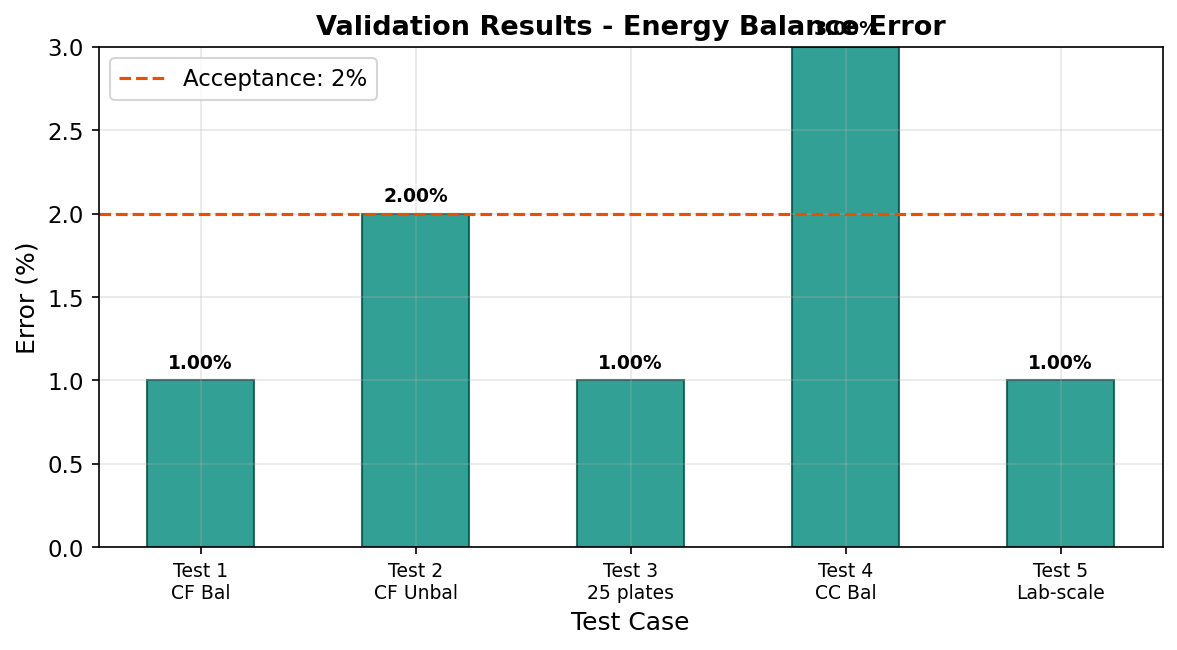
Energy balance errors across all validation test cases
Figure 1. Energy balance errors across all validation test cases