Theory
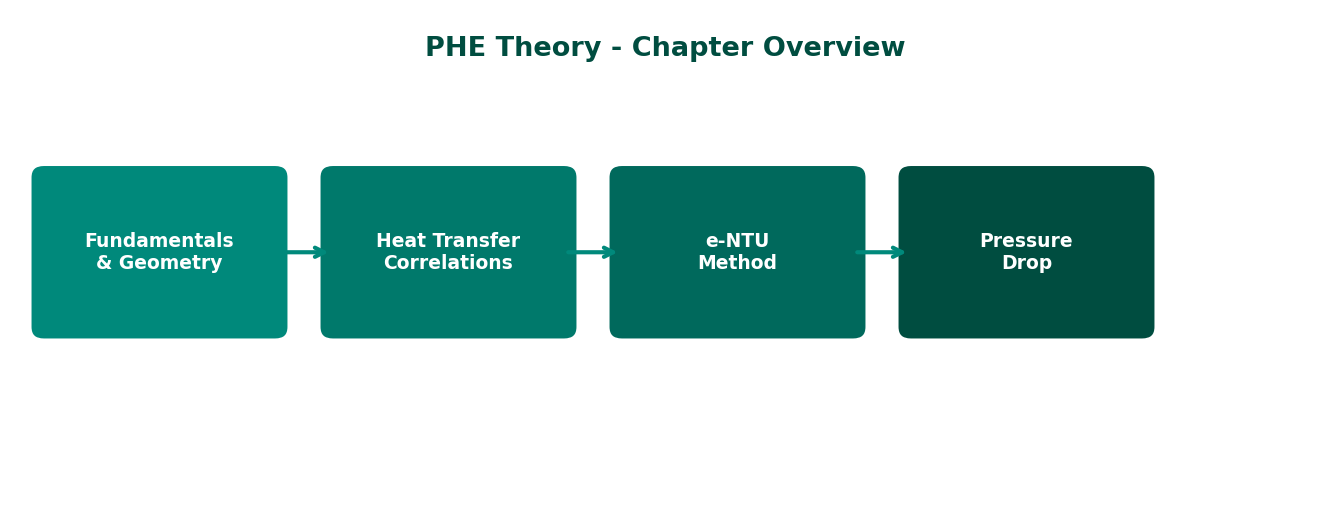
This section provides the complete theoretical foundation for the Plate Heat Exchanger unit operation, covering plate geometry fundamentals, heat transfer correlations, the effectiveness-NTU thermal design method, pressure drop modelling, and the iterative numerical solver.
| Chapter | Description |
|---|---|
| Fundamentals | Plate heat exchanger geometry, channel hydraulics, key performance metrics, and flow arrangements |
| Heat Transfer Correlations | Martin (1996) generalised Leveque Nusselt correlation, overall heat transfer coefficient, and fouling |
| Effectiveness-NTU Method | The e-NTU method for counterflow and co-current configurations with outlet temperature calculation |
| Pressure Drop | Kumar (1984) friction factor correlation, chevron angle correction, and channel pressure drop |
| Numerical Methods | Iterative property evaluation, PH flash integration, convergence strategy, and heat leak implementation |